From grandmaster failover towards a multi-master ensemble
GM7 prepares a backup while the primary is healthy. A future multi-master mesh could let several clocks contribute continuously to each receiver’s time estimate.
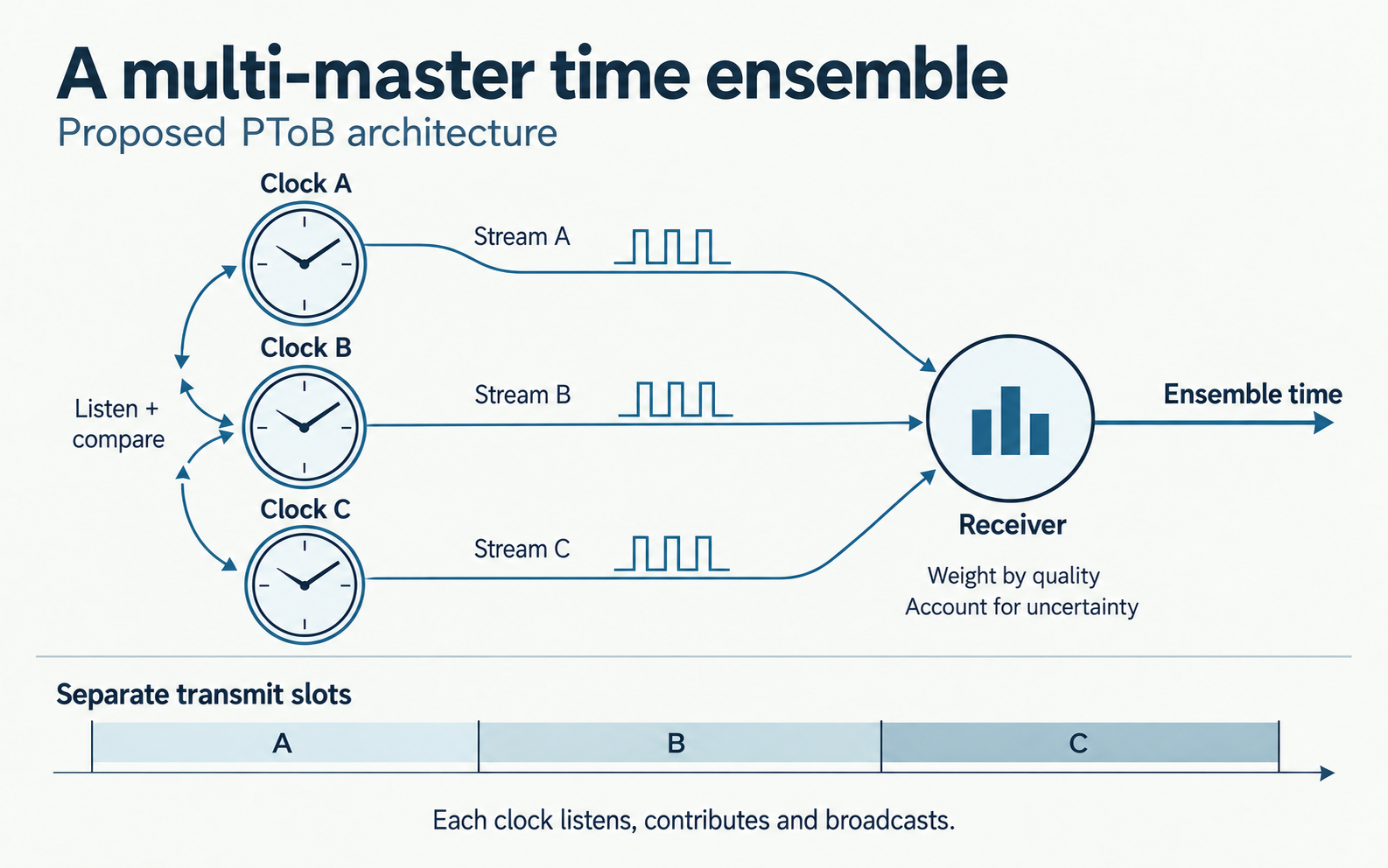
Precision time redundancy means keeping useful time available as clocks, references and radio paths change. GM7 approaches this by preparing a backup while the primary is healthy. A future multi-master mesh could extend that idea, allowing several clocks to contribute continuously to each receiver’s time estimate.
A prepared alternative time source
Today, GM7 coordinates one ACTIVE grandmaster, one designated HOT successor and other available candidates. The HOT clock follows the ACTIVE stream while maintaining its own qualified GNSS/PPS reference. Broadcast announcements identify the successor, and ordinary status messages report readiness.
This preparation makes recovery practical. The backup already knows the mesh and the relationship between their clocks. If the primary disappears, the designated HOT can take over through the fast path while other candidates retain the slower election process. The successor preserves the mesh’s identity, and a returning primary can join as a follower.
A deliberate reboot trial demonstrated that transition, including replacement precision transmissions and the restarted clock following the new source. Wider reliability and delivered precision throughout a handover still need separate measurement. The useful foundation is a prepared alternative time source.
Three clocks contributing continuously
The next question is whether those alternatives could help improve time before a failure occurs.
Our proposed direction is a three-clock multi-master ensemble. Each clock would receive the others’ precision streams and broadcast its own stream in a separate slot. A would transmit while B and C listen, followed by B’s slot and then C’s. Nearby receivers could observe all three.
Each participating clock would maintain its local oscillator, track the incoming streams and produce a disciplined output. A receiver could combine several valid observations into an ensemble time estimate, adjusting each contributor’s influence as conditions change.
Clock ensembles are an established timekeeping technique. NIST’s AT1 algorithm models individual clocks and gives greater weight to those with better measured stability. PToB would explore that principle across inexpensive devices connected by radio. NIST’s ensemble description provides useful background.
Quality across a dynamic mesh
In a wireless mesh, quality must include the journey. A stable clock received directly may offer a better observation than the same clock reached through a noisy or aging relay path. Each stream would carry its source identity, reference health, age and inherited uncertainty. The receiver would account for its own timestamp capture and transport effects.
Before blending, observations would be translated to a common instant and checked for compatible time scales. The receiver could then favor better supported predictions, reduce the influence of aging streams and exclude faulty inputs. Unknown delays would remain unknown; a small fitting error alone would not justify a small uncertainty.
This would create a dynamic mesh of overlapping ensembles. One receiver might favor A’s direct stream, while another obtains better observations through B. If C loses its reference, its contribution could diminish or expire. Receivers already tracking the remaining streams would have alternatives available without starting acquisition from scratch.
The difficult part is preserving independence. If A incorporates B’s time and B later incorporates A’s output, the same information can circulate and appear to be several agreeing sources. Contribution history must prevent repeated information from gaining extra weight. Shared GNSS errors also remain shared, regardless of how many clocks report them.
The goal is a mesh that adapts its time estimate to the evidence available locally, carries uncertainty through every hop and exposes declining confidence during outages. GM7 supplies the starting point: a working source and a prepared successor. A multi-master ensemble would make those additional clocks useful continuously, improving redundancy while exploring how much precision their combined observations can deliver.