ESP32-S3 · W12 timing architecture
Trace BLE reception into the disciplined local clock, then follow the relay’s timing train publisher from each new original to its later correction. Inspect phase, rate, publication and PPS evidence along the working RC1 / RC2 path.
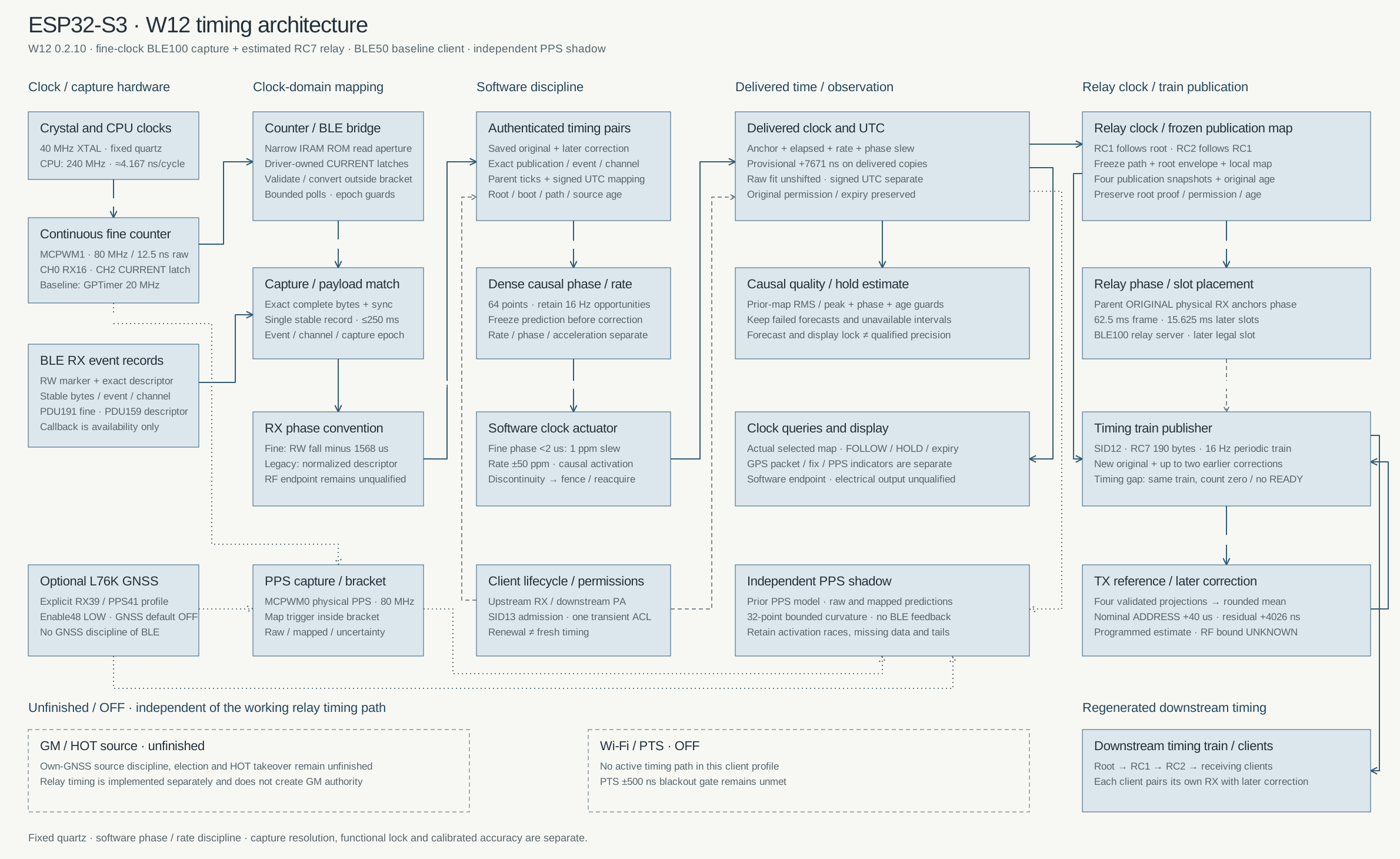
Trace the explicit fine-clock BLE100 capture path, causal clock and estimated RC7 relay publisher. BLE50 keeps its separate baseline counter path. Optional GNSS is a read-only witness; GM/HOT remain unsupported.
W12 0.2.10 · explicit fine-clock BLE100: MCPWM1 80 MHz · BLE50 baseline client-only · estimated RC7 relay · GNSS shadow only on the verified profile.
Logical architecture reviewed against PToB W12 0.2.10 / source b5ecbb0. This is a source map for understanding and diagnosis, not live telemetry or a wiring diagram. Local timer, BLE capture and PPS capture resolutions are distinct; calibrated electrical output and absolute UTC remain separate measurements. Measured W12 clock and relay results. Read the low-level timing paper (PDF).
Implementation scope and reference sources
This view follows PToB W12 0.2.10 at source b5ecbb0: the explicit fine-clock BLE100 backend, persistent MCPWM1 counter, exact marker/packet association, capture-frozen dense fitting and narrow IRAM bridges. BLE50 retains its baseline GPTimer path. RC7 publication uses immutable snapshots, source expiry and estimated TX; GM/HOT are unsupported.
Four independently validated programmed-clock projections supply a rounded mean; nominal LE1M ADDRESS is start plus 40 microseconds. Provisional +7671 ns delivered receive phase and +4026 ns relay residual remain separate from the raw fit. Transfer across other units/profiles, RF delay and calibrated UTC remain unqualified. GNSS is an explicit read-only profile; no pending producer-fix deployment result is claimed here.