The economics of laboratory sensor timing with PToB
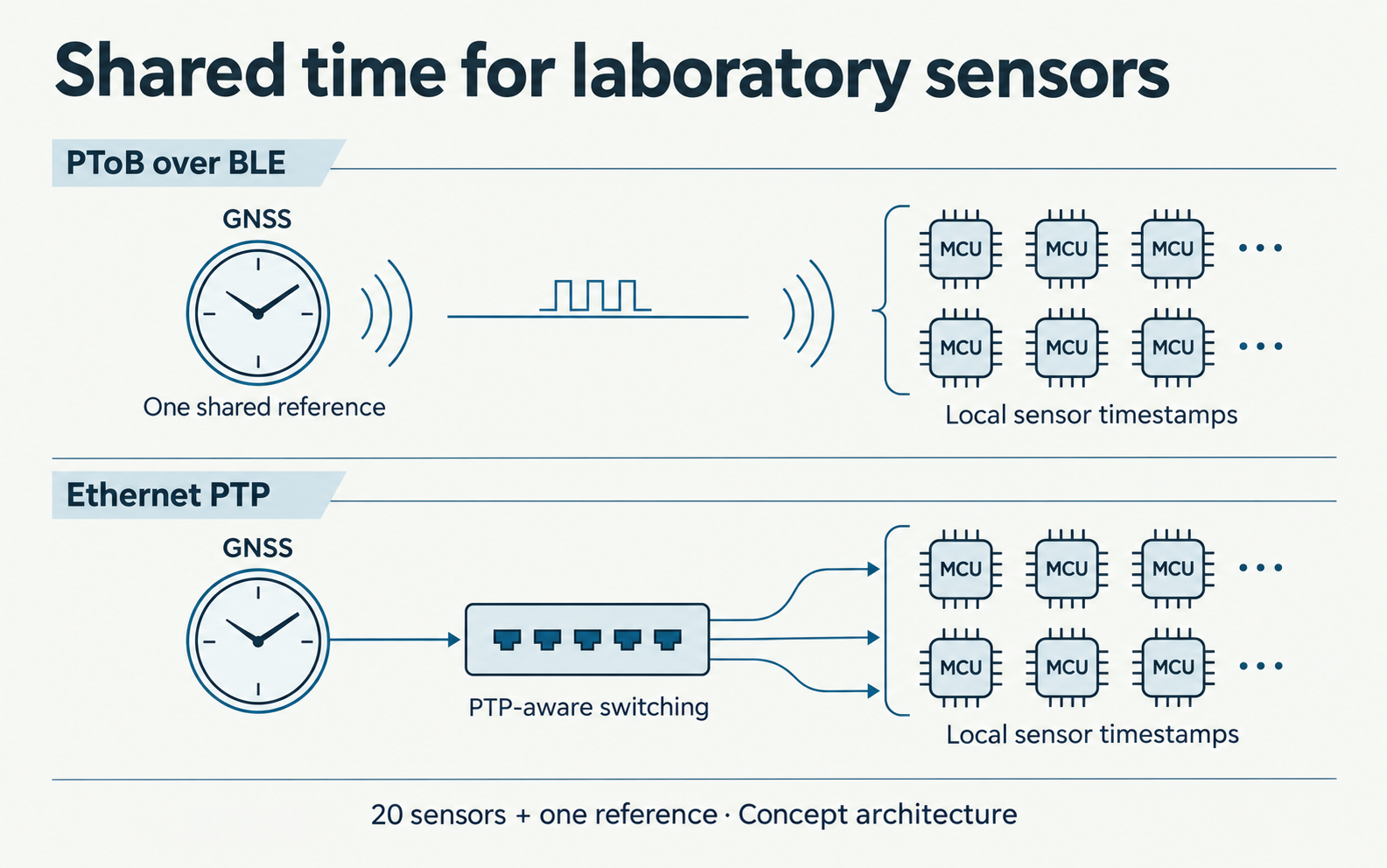
A shared BLE reference could put precision timing within reach of inexpensive sensor controllers. We compare the hardware budgets with embedded Ethernet PTP, including the switch needed to account for forwarding delay.
- PToB · ESP32-S3Six three-packs + two singles
- $156.34
- PToB · nRF52840Twenty at the quantity price
- $211.90
- Ethernet · ordinary switchSTM32 controllers + unmanaged switch
- $905.18
- Ethernet · PTP-aware switchSame STM32 build + NETGEAR M4250
- $2,013.10–$2,415.18
The extended final bar shows two dealer prices for the same switch. Hardware-only models; XIAO ports and a matched 20-node precision comparison remain to validate. No value is assigned to cabling flexibility.
Read the itemized PToB budgetsA laboratory sensor network needs to know when measurements happened. An accelerometer, optical detector and pressure transducer can produce excellent data individually yet become difficult to combine if their clocks disagree. Precision timing turns separate streams into observations of the same experiment.
That timing infrastructure can also consume a surprising share of the budget. Ethernet Precision Time Protocol, or PTP, is an established answer. PToB explores a different economic model: distribute a shared clock over Bluetooth Low Energy and let inexpensive sensor microcontrollers timestamp measurements locally.
For a modeled laboratory with 20 sensor controllers and one shared reference, PToB hardware comes to approximately $156–$212. A development-board Ethernet PTP system with an ordinary switch comes to $905. Replacing that switch with a representative PTP-aware managed model raises the wired hardware budget to approximately $2,013–$2,415.
These are hardware acquisition models, with different levels of implementation maturity—not a measured comparison of equally qualified systems. Nevertheless, they expose a compelling opportunity: useful precision timing could become a small, shared expense rather than a substantial additional interface at every sensor.
The calculation assigns no monetary benefit to the flexibility of wireless placement. Cable installation, bench rearrangement and the constraints of structured cabling are outside it.
Start with the sensor controller
The appropriate wired comparison uses standalone microcontrollers. Both architectures can acquire sensor data, capture events and maintain a local clock without placing a computer at every measurement point.
PToB’s proposed low-cost endpoint is a BLE-capable MCU that performs both sensing and timing. One GNSS-backed grandmaster supplies the common reference. Receivers do not each need their own satellite receiver or antenna.
The reference prices below are in US dollars, before tax, tariffs and delivery. Manufacturer and dealer pages were checked on 3 November 2026; promotional and quantity prices can change.
| Hardware | Price used | Role in the model |
|---|---|---|
| Heltec T096 | $33.90 | Shared GNSS-backed PToB reference |
| XIAO ESP32-S3 | $7.49 | Candidate sensor controller |
| XIAO ESP32-S3 three-pack | $17.91 | Lower-cost endpoint purchasing |
| XIAO nRF52840 | $8.90 at 10 or more | Alternative candidate controller |
| STM32 NUCLEO-F767ZI | $34.39 | Ethernet PTP sensor or reference controller |
The XIAO boards are costed porting candidates. PToB results on other nRF52840 and ESP32-S3 boards do not establish their performance or supply a finished XIAO firmware image. A port must preserve the required radio-event association, timer access and sensor capture path. The project remains a developer preview.
These are accessible development-board prices, not a claim about the minimum production BOM for either technology. The STM32 also offers different compute and I/O resources; its entire price difference cannot be attributed to PTP.
A low-cost Ethernet baseline already costs more
The NUCLEO-F767ZI is a credible embedded PTP starting point. ST documents IEEE 1588v2 hardware support in the STM32F767 Ethernet MAC, and Zephyr lists the board as a PTP sample target. The firmware still needs to connect packet timestamps, clock control and sensor events correctly. ST specifications, Zephyr PTP documentation.
The following model provides 20 sensor controllers, an additional MCU reference controller and an ordinary 24-port switch.
| Ethernet hardware | Quantity and unit cost | Extended cost |
|---|---|---|
| STM32 Ethernet sensor controllers | 20 × $34.39 | $687.80 |
| STM32 grandmaster controller | 1 × $34.39 | $34.39 |
| GNSS/PPS reference allowance | 1 × $30.00 | $30.00 |
| Ordinary unmanaged switch allowance | 1 × $89.99 | $89.99 |
| Patch cable allowance | 21 × $3.00 | $63.00 |
| Total | 20 sensors plus one reference | $905.18 |
The GNSS, ordinary-switch and cable amounts are explicit budget allowances retained from the initial economic model. The STM32 grandmaster is an engineering build assumption; a board and GNSS module are not a completed, calibrated PTP appliance.
This is already a restrained wired comparison. It includes no PC, commercial grandmaster appliance or premium timing switch. Common sensing elements, power supplies, enclosures, software development and calibration are excluded from both architectures.
Even removing the entire switch and patch-cable allowance leaves $752.19 of Ethernet controllers and reference hardware. Most of the baseline difference therefore comes from the selected endpoint platforms, not the cable bill.
The ordinary switch has a precision caveat
Hardware timestamps identify when PTP packets enter or leave the MCU’s Ethernet MAC. They do not reveal all the delays a packet encounters inside an ordinary switch. Unequal forward and reverse delays can become clock error: a persistent 200 ns path asymmetry creates approximately 100 ns offset bias. Cisco’s PTP explanation.
The STM32F767 interface is 10/100 Ethernet. Connecting it to a Gigabit switch does not turn that endpoint into a Gigabit device. At 100 Mb/s, 1,500 bytes alone take 120 µs to serialize, excluding wire overhead. A PTP packet waiting behind traffic can therefore encounter delays far larger than a 100 ns budget. Priority and filtering can help, but do not themselves measure switch residence time.
STM32 hardware can perform well: a developer reported roughly ±100 ns with custom drivers, a modified PTP daemon and light traffic, checked against PPS. That 2024 first-person report does not establish the same result through an unmanaged switch.
Ilya Voloshin’s 2026 thesis tested F767ZI boards directly and through an ordinary switch with two followers:
| PTP log metric | Direct connection | Ordinary switch |
|---|---|---|
| Offset standard deviation | 173–243 ns | 214–335 ns |
| Absolute offset P99 | 405–771 ns | 575–945 ns |
| Mean path delay | 0.964–0.983 µs | 8.139–8.353 µs |
These are log statistics, not external PPS RMS. Separate PPS measurements corroborated physical timing behavior. The long switched run retained 43,028 log samples per follower, with P99 values of 704 and 586 ns. Under 60–70 Mb/s background traffic, filtering rejected over 82% and about 89% of measurements; at 75 Mb/s, stable synchronization was lost and later recovered after load removal. These are implementation-specific results, not universal Ethernet thresholds. Thesis, Tables B.2, B.3 and B.6.
The $905 architecture is consequently a plausible economical PTP build, but it has no demonstrated entitlement to continuous sub-100 ns operation across 20 active sensors.
Budget for a switch that measures its own delay
A practical upgrade is the NETGEAR M4250-26G4F-PoE+, model GSM4230P-100NAS. Its 26 copper ports accommodate 20 sensor controllers and a reference. The M4250 family implements a PTPv2 one-step end-to-end transparent clock, which measures residence time and updates the relevant PTP correction information. NETGEAR product specifications, M4250 datasheet.
This targets the unmeasured switch-delay problem directly. Merely buying a managed switch with VLANs and QoS would not provide that function.
| Switch option | Switch price | Complete modeled STM32 system |
|---|---|---|
| Ordinary unmanaged switch allowance | $89.99 | $905.18 |
| M4250 listing at Barcodes Inc | $1,197.91 | $2,013.10 |
| Same M4250 listing at B&H | $1,599.99 | $2,415.18 |
A reasonable planning allowance is therefore $1,200–$1,600 for this switch, adding approximately $1,108–$1,510 over the ordinary-switch budget. This is a representative purchasable option, not the cheapest possible PTP network; it also includes AV and PoE features that this model does not use.
The transparent clock must be enabled for the chosen profile and ports. The STM32 implementation must use compatible end-to-end PTP and consume corrections correctly. NETGEAR documents profile-dependent enablement and incompatibility with its 802.1AS AVB mode. Configuration manual.
| Error source | What the PTP-aware switch changes |
|---|---|
| Variable residence time inside the switch | Measures and compensates it for supported PTP traffic |
| Endpoint PHY or cable asymmetry | Still requires characterization where material |
| MCU timestamp association and servo error | Remains an endpoint implementation responsibility |
| Packet loss or an overloaded endpoint | Still requires traffic engineering and testing |
| Sensor acquisition latency | Requires local event capture and calibration |
The upgrade removes the need to guess supported switch residence delays; it does not eliminate every timing error or guarantee sub-100 ns performance. Loaded, end-to-end measurements remain necessary.
PToB keeps the shared infrastructure small
PToB’s economic advantage comes from distributing one timing stream to compatible receivers while retaining local sensor timestamps. Each endpoint avoids adding Ethernet solely to obtain a clock.
Using the listed purchase options produces these acquisition budgets:
| PToB configuration for 20 sensors | Endpoint hardware | One T096 reference | Total | Per sensor |
|---|---|---|---|---|
| ESP32-S3, six three-packs plus two singles | $122.44 | $33.90 | $156.34 | $7.82 |
| ESP32-S3, all individual boards | $149.80 | $33.90 | $183.70 | $9.19 |
| Mixed, ten ESP32-S3 and ten nRF52840 | $150.22 | $33.90 | $184.12 | $9.21 |
| nRF52840, twenty at the quantity price | $178.00 | $33.90 | $211.90 | $10.60 |
The mixed purchase uses three ESP32-S3 three-packs and one individual board, plus ten nRF52840 boards. Every total includes exactly 20 endpoint controllers.
| Comparison | ESP32-S3 bundle model | nRF52840 model |
|---|---|---|
| Saving against $905.18 ordinary-switch Ethernet | $748.84 / 82.7% | $693.28 / 76.6% |
| Saving against $2,013.10 PTP-aware Ethernet | $1,856.76 / 92.2% | $1,801.20 / 89.5% |
| Saving against $2,415.18 PTP-aware Ethernet | $2,258.84 / 93.5% | $2,203.28 / 91.2% |
These percentages describe the selected hardware models. They do not establish production savings or equal delivered precision. They do show that PToB’s case survives both a modest wired baseline and a practical upgrade aimed at its main switching limitation.
For a laboratory watching the cost of each measurement channel, that is a substantial amount of budget left for sensing, analog electronics, fixtures and validation.
The timing research makes the economics worth pursuing
Low hardware cost matters when the clock can support useful work. PToB’s research has demonstrated small relative phase errors on particular native MCU configurations:
| Separate PToB experiment | Relative phase RMS | Observation population |
|---|---|---|
| Nordic path with one relay, 12 October | 62.504 ns | 436 valid comparisons / 602 conservative nominal PPS opportunities |
| W12 reception, 24 October, both windows | 60.328 ns | 522 eligible / 600 logged PPS records |
| W12, stable second window of that study | 38.312 ns | 300 / 300 eligible; subset of the preceding row |
These results use previously frozen empirical corrections. The first population retains reference gaps and map expiry; the W12 full population retains 78 unavailable records. The stable subset cannot replace the full denominator. They demonstrate relative phase behavior, not calibrated absolute UTC, continuous availability or XIAO-board performance. PToB viability research, 30 October edition.
The STM32 thesis and PToB studies use different implementations, populations and metrics. Dividing their headline numbers would not produce a defensible performance ratio.
The economic proposition is nonetheless strong: PToB has demonstrated tens-of-nanoseconds relative phase RMS on tested MCU hardware while pursuing an endpoint architecture costing only a few dollars per controller. A 20-sensor implementation still needs its own accuracy, availability and workload tests.
That distinction matters for sensor fusion. Capture the actual acquisition event in hardware where required, map that timer into the synchronized clock, and retain source validity with the sample. An interrupt callback or the completion of a sensor read can occur after the physical measurement. Neither a fine clock nor a PTP switch automatically removes that latency.
Existing compatible sensors offer the largest incremental saving
A laboratory may already own BLE-capable sensor controllers. If their radio and timer resources support a successful PToB port, the additional timing hardware can be the shared reference alone.
| Existing-node scenario | Additional timing boards | Hardware outlay | Amortized across 20 sensors |
|---|---|---|---|
| One shared reference | One T096 | $33.90 | $1.70 each |
| Two reference candidates | Two T096s | $67.80 | $3.39 each |
| Three infrastructure clocks | Three T096s | $101.70 | $5.09 each |
Extra clocks do not by themselves establish redundancy, coverage or seamless failover; the selected topology must be implemented and tested. Even so, the hardware cost of experimenting with additional reference or relay capacity is modest.
Timing also need not dictate how measurements reach the analysis machine. Timestamped samples can be buffered locally and transferred over an appropriate data connection. PToB does not replace the bandwidth needed for camera streams or other large datasets; any additional data-network hardware belongs in a complete deployment budget.
The same incremental reasoning applies fairly to Ethernet. If the lab already has suitable PTP-capable endpoints and qualified timing infrastructure, retaining them may be the least expensive choice. The strongest PToB case is a new deployment of modest sensors, or an existing BLE design that would otherwise acquire Ethernet specifically for synchronization.
Engineering cost determines the final return
A research laboratory must budget for working measurements, not just boards. Porting, provisioning, calibration, interference testing, failure handling and maintenance can exceed the acquisition bill. Both systems require that work, and the XIAO PToB builds remain prospective.
A useful way to evaluate the hardware saving is to ask how much additional integration effort would consume it. The following calculation uses an illustrative $100 per engineering hour, with the ESP32-S3 bundle model as the PToB baseline:
| Wired comparison | PToB hardware headroom | Additional PToB effort that would consume it |
|---|---|---|
| Ordinary-switch STM32 build | $748.84 | 7.49 hours |
| Lower listed PTP-aware build | $1,856.76 | 18.57 hours |
| Higher listed PTP-aware build | $2,258.84 | 22.59 hours |
This is a break-even sensitivity calculation, not an estimate of integration time. Reusable firmware can spread development across many experiments; a difficult one-off port can reverse a hardware-only saving. Conversely, an established STM32 PTP implementation can have substantial reuse value.
The meaningful comparison is therefore cost per endpoint that meets the laboratory’s actual timing and availability requirement. Measure pairwise sensor error, P99, maximum excursions and missing or unusable observations under the intended workload. Keep clock synchronization and physical acquisition accuracy separate.
Energy and maintenance may also matter over time, but no unmeasured battery-life or operating-cost saving is credited here.
Make precision timing a shared laboratory resource
PToB offers an attractive direction for sensor fusion: establish time near the measurement, share the reference across inexpensive MCU endpoints, and choose data transport according to the experiment.
In this 20-sensor model, approximately $156–$212 buys the proposed PToB controller and reference hardware, versus $905 for embedded Ethernet with ordinary switching. A representative switch upgrade that compensates its own PTP residence time takes the wired model to approximately $2,013–$2,415. Existing compatible BLE controllers reduce PToB’s incremental reference-board expense to $33.90.
The opportunity is to make precise event correlation affordable enough to include early in an experiment’s design. PToB’s measured native-clock results justify pursuing that opportunity; qualification must establish how well each complete sensor system delivers it.
For laboratories building many modest measurement nodes, PToB deserves serious consideration as a cost-effective timing architecture—even before assigning any value to avoiding structured-cabling constraints.
Explore the PToB research and implementation and porting guide.