Next-Gen WWVB for your Wrist
Our new T-Watch Ultra target explores a familiar idea with much finer timing. Broadcast a good clock, let every watch listen, and give the sensors the same time too.
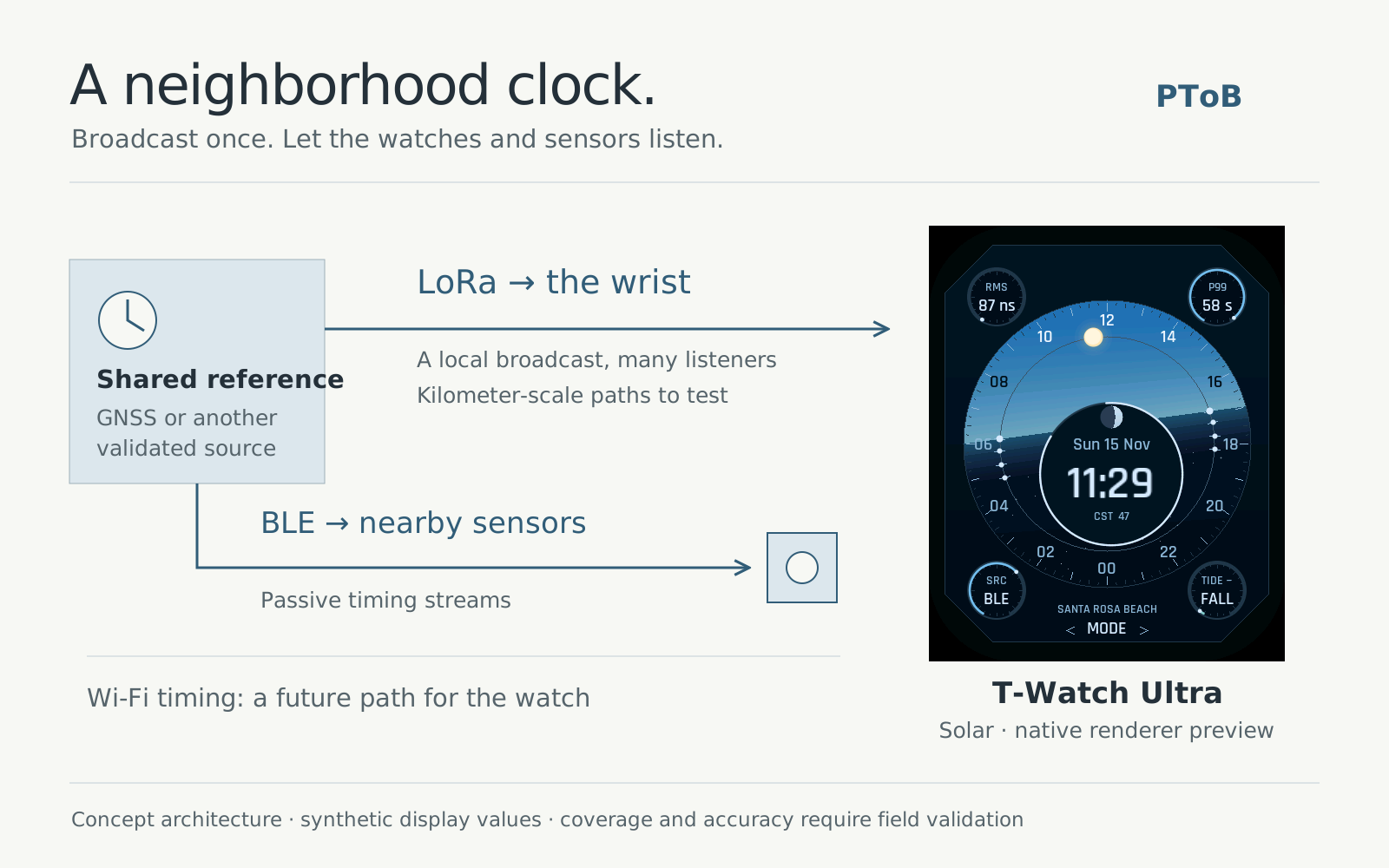
There is something pleasing about a watch that quietly gets the time from the air. Leave it near a window, wake up, and the hands agree with the rest of the world. Radio-controlled watches have been doing that for decades. The ambition behind our new LILYGO T-Watch Ultra target is to bring that convenience to a much finer clock—and make the same time available to everything else nearby.
Imagine a suitable LoRa transmitter a couple of kilometers away. Your watch listens. So do the weather station, the garden sensors and the little data logger in the workshop. Indoors, compatible devices can follow PToB’s passive BLE timing streams. A single reference can serve many listeners without a separate time request from each one.
Sub-1 ms synchronization is a practical engineering target for this architecture, with substantial room to do better. PToB has already measured much smaller errors in specific BLE and calibrated LoRa experiments. Qualifying that performance across a real neighborhood is the next job. The T-Watch gives us a particularly enjoyable place to start: finally, a reason to check your wrist that involves oscillator drift.
The T-Watch Ultra already achieves sub-100 ns relative timing over BLE. So “sub-1 ms” leaves a little headroom.
WWVB had the right idea
NIST’s WWVB broadcast distributes time on a 60 kHz carrier from Colorado. Consumer clocks and watches typically synchronize overnight, then keep time with their own quartz oscillators between receptions. The receiver does not need to log into a service or ask the transmitter for a personal update. A broadcast serves everyone who can receive it.
We want to carry that idea into a local, programmable network. A PToB transmitter could supply a neighborhood, campus or field installation; BLE could cover nearby rooms and equipment. The receiver would learn both the current time and how quickly its own clock runs, so it can predict forward between radio observations.
“The next WWVB” is the inspiration here. PToB uses different radios and packets, and existing WWVB watches cannot decode them. A national longwave service and a local LoRa installation also solve different coverage problems. What we want to preserve is the wonderfully simple experience: turn on a compatible clock and let it listen.
Apple Watch makes 50 ms feel ordinary
Apple helped establish a useful expectation: a connected watch should know the time without being set by hand. Its March 2015 launch announcement specified timekeeping within 50 milliseconds of UTC, with a footnote requiring regular synchronization with an iPhone. That is the historical claim behind the familiar “under 50 ms” description, rather than a new measurement of today’s watches.
In his 2015 timekeeping interview, Apple’s Kevin Lynch described GPS-backed network time servers and compensation for the delay when time passes from the phone to the watch. The general principle is straightforward: obtain a good reference, account for the transfer, and keep a stable local clock between updates. Simply setting a clock to the timestamp in a message when the app receives it would include the message’s journey and software delays.
PToB takes that last problem down toward the radio event itself. A compatible receiver timestamps an identifiable event against a local counter, associates it with the transmitter’s reference, and estimates the relationship between the two clocks. The watch face can draw later; the clock underneath still refers to the captured event. Display refresh and sensor timestamp accuracy are separate questions.
Going from 50 ms to 1 ms makes the interval 50 times smaller. A microsecond is another thousand times shorter. Those conversions show the scale of the opportunity; they are not a matched performance comparison with Apple Watch.
Meet the T-Watch Ultra
The Ultra’s ESP32-S3, AMOLED and SX1262 radio make it an appealing development watch for this experiment. Our target supports Ultra V1 with SX1262, with BLE preferred and passive LoRa reception running alongside it when enabled. The selected radio variant matters: the SX1280 version is not supported by this target’s sub-GHz fallback.
We have built three faces around the same clock. Digital puts time and source status up front. Instrument turns reception, lock, timing fit and reserve into analog complications. Solar follows the sun, twilight and moon, with small dials for timing quality and predicted tides. Accurate time can still have a little personality.
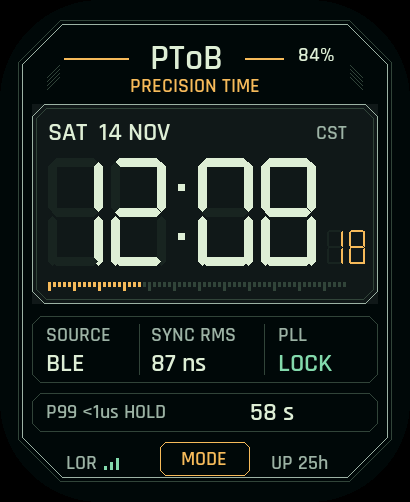
Digital
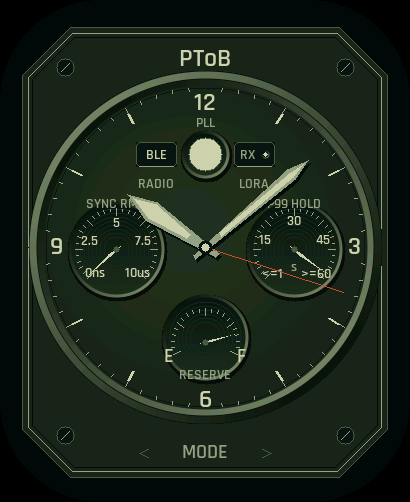
Instrument
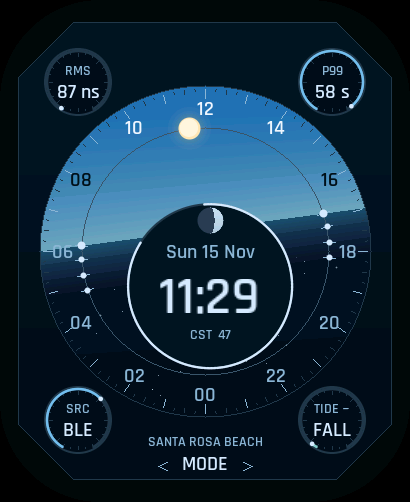
Solar
These are real renderer outputs from the new source target we are preparing for GitHub. The watch remembers the selected face, brightness and screen timeout. Swipes switch faces; the launcher opens Settings. Solar currently uses a configured Florida location and tide station; GNSS stays off and location does not follow the wearer automatically. Our T-Watch Ultra hardware guide covers its faces, controls and timing paths.
One transmitter, many listening clocks
The useful trick is to separate when an event happened from when its description arrived. A LoRa transmission takes time. Driver work and packet handling take time too. PToB’s two-step timing can describe an earlier physical transmission in a later authenticated message. The receiver pairs that description with its retained radio-event capture, rather than treating packet delivery as the time reference.
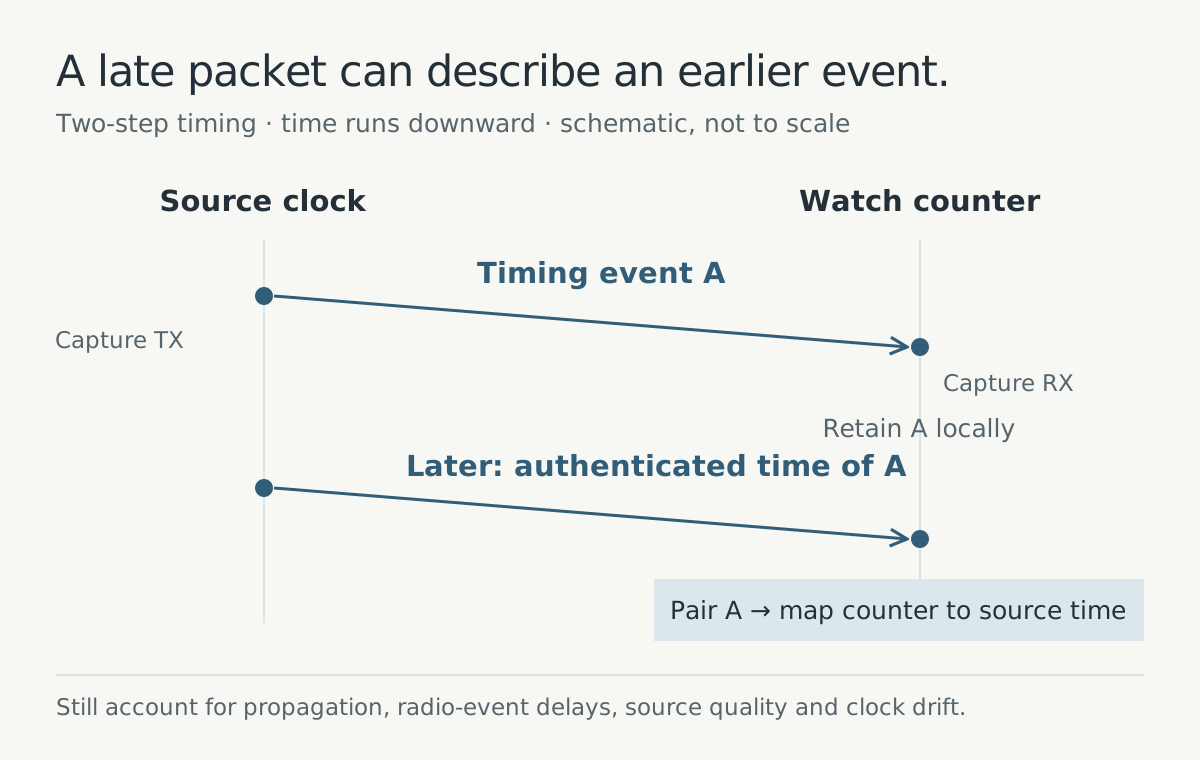
That structure suits a broadcast. More listening devices do not require more timing replies. BLE receivers can likewise consume passive timing streams without exchanging a time request for every sample. Authentication, compatible firmware and usable event timestamps still matter; adding a Bluetooth logo to a sensor does not automatically give it a PToB clock. Some mesh roles also use separate control exchanges for admission and maintenance.
At 2 km, free-space travel time is about 6.7 µs. That is small beside a 1 ms goal, although it matters a great deal when chasing a microsecond. The larger practical questions include the radio’s timing reference, fixed receive delays, antenna placement, interference and the watch’s changing orientation. A couple of kilometers is a useful deployment scenario to test, not a promised coverage radius around every transmitter. Regional radio settings and airtime limits also shape the installation.
How much precision is already plausible?
Our ESP32-S3 BLE study measured 166.590 ns relative PPS RMS in a 660-second experiment, with 657 eligible and three invalid records. That result comes from a different target and a defined observation path. It shows what careful event capture and clock discipline can achieve on this class of hardware.
The newer LoRa paper prepared for our next repository update reports 269.140 ns RMS over all 900 future PPS observations, after a fixed correction learned from earlier bench measurements. The largest observed error was 624 ns. This was a calibrated comparison at GNSS inputs against the delivered clock model, with a substantial fixed native-input delay accounted for in advance. It does not establish independent electrical output accuracy, portable UTC accuracy or kilometer-range performance. An earlier incomplete attempt remains separate in the paper.
Those results make a millisecond a comfortably larger engineering budget. They do not transfer automatically to the T-Watch. Its default BLE receive measurements have 500 ns bins, and each watch capture path needs its own validation. Internal Sync RMS describes agreement with the fitted model; it cannot reveal every fixed bias shared by the observations. The wristwatch’s absolute accuracy still needs an independent reference.
The encouraging part is that we are not asking an inexpensive crystal to become an atomic clock. We are teaching it its rate, observing it again, and keeping track of when the information is getting old.
BLE nearby, LoRa farther away, Wi-Fi next?
BLE is attractive where a transmitter or relay is already nearby. Watches, environmental sensors and acquisition boards can share a local time base while receiving the same stream. LoRa offers a way to reach beyond that local area, potentially keeping a watch synchronized on a walk where the BLE source no longer reaches.
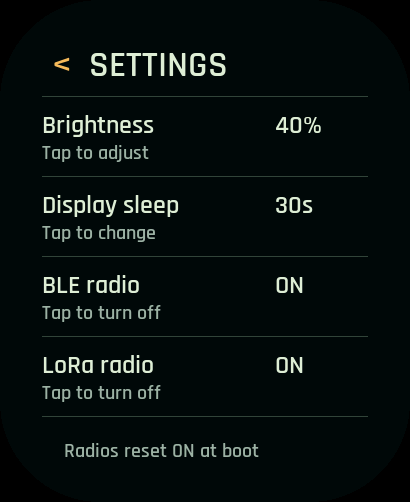
The current T-Watch prefers valid BLE timing and can use its separate LoRa clock when BLE is unavailable. If fresh timing disappears, HOLD keeps the displayed clock advancing from the last valid estimate. Its accuracy then becomes unknown; the display can continue until reboot, but that does not promise indefinite precision. A continuing clock and a qualified timing source need different labels.
Wi-Fi is another promising path for devices that already have it. Our separate Wi-Fi beacon and NTP study measured calibrated input-phase RMS of 19.226 µs and 8.240 µs across two 900-PPS runs. That is encouraging evidence for further work, with its own calibration and qualification limits. Wi-Fi timing is not implemented in this T-Watch target. It is a direction to explore alongside BLE and LoRa, rather than a capability implied by the watch’s Wi-Fi hardware.
The watch is only the beginning
Your appointment probably does not need a microsecond. A collection of sensors may benefit much more: aligning vibration recordings, comparing environmental events, or associating a wearable observation with a nearby instrument. Better clock agreement makes those comparisons easier, provided the device also timestamps the actual sampling event. Sensor buffering can otherwise hide the improvement.
The T-Watch makes the idea tangible. You can see the source, see the clock state, and choose a face that looks like a watch rather than a bench instrument. Around it, the same broadcast could support useful devices with no screen at all.
Our next steps are to measure the watch against an independent reference, walk real radio paths, test transitions between BLE and LoRa, and measure the battery cost. The T-Watch target, build guide and supporting LoRa study are prepared for the next PToB GitHub update. These destinations become available with that upcoming push. There is no generic watch image or public one-click installer yet.
A little transmitter, many listening clocks, and a shared time base for the neighborhood: WWVB supplied a very good idea. We would like to put its next local chapter on your wrist.